
Brewing Value: The Caffeinated Economics of Experience
Brewing Value: The Caffeinated Economics of Experience
The U.S. coffee industry didn’t just expand over the past two decades; it redefined what growth means in the category. In the early 2000s, the industry generated approximately $11 billion in annual revenue across roughly 20,000 locations. By 2025, that figure has grown to $74.3 billion across approximately 77,500 locations. The implication is more telling than the headline: revenue has grown nearly twice as fast as physical footprint. In other words, the product’s value has scaled faster than the real estate required to deliver it.
This shift was not driven by increased consumption. Americans have long been habitual coffee drinkers. What changed was the nature of the visit itself. The emergence of specialty and independent concepts introduced a model centered on personalization, quality, and brand identity, things that traditional chain formats were not designed to deliver at scale. The handcrafted beverage, the sourced ingredient, and the founder-led story are not ancillary to the experience; they are the product. These concepts expanded the category, capturing incremental consumer spend that standardized formats could not have generated on their own.
The data reflects a market at a structural inflection point. In 2025, daily specialty coffee consumption surpassed traditional coffee in the United States for the first time: 46% of American adults reported drinking specialty coffee in the past day, compared to 42% who drank traditional coffee, according to the National Coffee Association. That figure represents an 84% increase in daily specialty consumption since 2011. The market is not simply growing; it is reordering itself around a different kind of product.
Forecasts reinforce this hypothesis. The U.S. specialty coffee segment was valued at 7.8 billion in 2024 and is projected to grow at a 9.5% CAGR through 2030, according to Grand View Research. The mass-market segment is forecasted to grow at 1.3% per year over the same period. Growth is no longer evenly distributed across the category; it is concentrated entirely within the experience-driven half. Among consumers aged 25 to 39, the segment is expected to grow fastest at a 10.3% CAGR; specialty coffee functions as more than just a way to get caffeine; it is part of a daily ritual that is tied to quality, productivity, experience, and identity.
Critically for retail real estate, specialty coffee is not primarily a home behavior. Away-from-home channels—coffee shops, cafés, and experiential formats—accounted for 70.7% of U.S. specialty coffee revenue in 2024, per Grand View Research. Nearly three-quarters of all specialty coffee spending happens in a physical location. This is not a beverage trend. It drives foot traffic in structural, recurring, and loyalty-reinforced ways that commodity coffee formats don’t. Digital engagement has further accelerated this dynamic. Emerging concepts have built loyalty ecosystems that translate directly into higher annual spend and repeat visitation. Loyalty members at coffee concepts spend on average 32% more annually than non-members.
What began as a consumer behavior shift is now expressing itself in retail real estate performance. At Main Street Shopping Center in Kennesaw, Georgia, a top-performing Starbucks location was vacated as part of a broader repositioning toward drive-through formats. Within eight days, the space was re-leased to Haraz Coffee House. The transaction required no landlord capital and no tenant improvement allowance, while achieving rent above the prior tenant. A nationally recognized chain exited the space, and a specialty operator not only replaced it, but improved the asset’s economics.
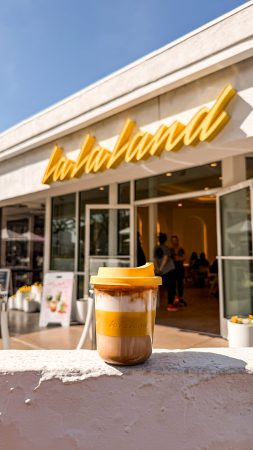
This outcome is not isolated. At Camelback Village in Phoenix, La La Land Kind Café has driven foot traffic up 23% center-wide, with lines extending beyond the storefront. At Boardwalk at Andersen Springs, Coffee Rush has built long-term community loyalty through a quality-focused model, showcased in high ratings and repeat visitation. Concepts such as Drip Queen Coffee are positioning themselves not simply as coffee retailers, but as destinations, capturing both product demand and experiential engagement in a single format.
As Lauren Ball notes, “We’re seeing a shift in where value is being created in the coffee category. Specialty concepts are gaining share, driven by higher pricing, larger tickets, and more frequent visits compared to traditional operators. Over the past three years, we’ve signed four new leases with boutique coffee operators and renewed six existing coffee tenants. This has led to better performance at the tenant level and higher sales per square foot. In Kennesaw, the new tenant didn’t just replace the prior tenant, they improved the overall economics of the space without additional capital. This reflects changing consumer preferences and a shift in market share within the category.”
At the same time, major chains are actively rationalizing their domestic footprints. Starbucks alone closed approximately 400 U.S. locations in 2025. That supply is increasingly being absorbed by experience-driven operators that are expanding into precisely these types of locations. In high-growth Sunbelt markets, where demographic trends support both premium spending and daily visitation, this alignment between available space and emerging tenant demand is particularly pronounced.
The broader takeaway is not that legacy operators have failed, but that experience-driven concepts have expanded the total market beyond what traditional formats alone could sustain. The result is a category characterized by higher average spend, increased frequency of visits, and stronger tenant performance. When these concepts intersect with well-located real estate, the impact is measurable, not only for the tenant, but for the asset and the portfolio as a whole.
Recommended

The Halloween Creep: What Early Fall Traffic Tells Us About Neighborhood Retail
