
AI Infrastructure Investment and Retail Ripple Effects: A Phoenix Perspective
AI Infrastructure Investment and Retail Ripple Effects: A Phoenix Perspective
AI Infrastructure Investment and Retail Ripple Effects: A Phoenix Perspective
The conversation around artificial intelligence investment has been dominated by the digital layer, chips, models, compute, and capital. What receives less attention is where that investment physically lands, and what it sets in motion when it does. The jobs it creates, the people it attracts, the communities that form around it, and ultimately, the retail that serves those communities.
This is not a new pattern. It is an old one playing out with new catalysts.
Retail real estate has always followed people. People follow opportunity. And right now, opportunity is concentrating in a handful of high-growth markets where AI-driven infrastructure investment is reshaping the economic landscape at scale. Phoenix is one of the clearest examples of that dynamic in motion.
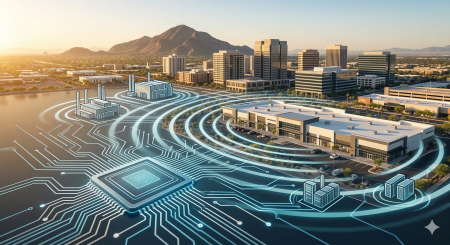
TSMC’s $5 billion fabrication campus along the 303 corridor in North Phoenix is one of the most significant manufacturing commitments in Arizona’s history. Combined with hyperscale data center expansion and supporting industrial investment, the region is absorbing a level of employment-generating capital that drives long-term workforce migration and residential development. These are not short-cycle projects. They represent decade-long economic anchors that fundamentally alter where people live, work, and spend.
Growth at this scale doesn’t move without complexity. Arizona is working through real considerations around land availability and water resources that will shape the pace of development over time. These are factors the state is actively managing — not obstacles, but the natural friction of responsible expansion in a high-demand market. They inform the timeline. They don’t change the direction.
These are not abstract technological trends. They are economic catalysts that alter how communities develop and where demand concentrates. Retail real estate rarely leads these transitions. It responds to them by serving the everyday needs of expanding populations.
The retail data reflects what the investment has already set in motion. The Phoenix region recorded more than 2.4 million square feet of positive retail absorption in 2025, including 832,000 square feet in the fourth quarter, alongside nearly 3.8 million square feet of leasing activity during the year. Asking rents increased approximately 5.8% year over year, while shopping center visitation exceeded pre-pandemic benchmarks, reaching 102% of prior levels. Vacancy has remained low, hovering near 5% over the past two years, reinforcing sustained demand for retail space.
These indicators point toward an environment supported by population growth and employment expansion rather than speculative development. Retail performance in this context reflects broader economic positioning rather than isolated sector activity. As residential development continues to extend northward along the 17 and 303 corridors, neighborhood retail demand will follow, serving the everyday needs of a workforce-driven population base.
Westwood Financial’s Fund portfolio operates within this same landscape. Across eight properties totaling 644,889 square feet, leasing engagement during 2025 included:
- Nine new leases totaling 20,872 square feet
- Seventeen renewals totaling 69,325 square feet
- Five assignments totaling 6,272 square feet
Collectively, more than 96,000 square feet, approximately 15% of the portfolio inventory, was actively engaged through leasing activity while maintaining 100 percent leased.
This level of activity reflects steady tenant demand rather than vacancy-driven turnover. In markets demonstrating absorption, rent growth, and high visitation, well-positioned neighborhood centers often serve as stable platforms for business expansion. Portfolio outcomes are influenced by market conditions, and Phoenix continues to illustrate how infrastructure investment and employment clustering translate into retail engagement.
From a capital perspective, the relationship between digital infrastructure and physical real estate is often framed as competitive. In practice, the two functions operate in tandem.
As Westwood Financial CFO Juyuan Wei notes, “Periods of concentrated investment in emerging technologies naturally raise questions about allocation balance. Innovation attracts attention, but physical environments remain essential to supporting population growth and economic activity. Disciplined capital deployment continues across sectors because communities still require housing, services, and retail infrastructure.“
Technological investment drives employment. Employment drives migration. Migration drives demand for goods, services, and everyday retail access.
Phoenix’s trajectory illustrates a broader pattern emerging across high-growth regions, one that includes both opportunity and the policy complexity that accompanies it. AI-driven capital deployment creates ripple effects that extend beyond industrial and digital assets. It shapes how communities expand, how land and resources are allocated, and how retail ecosystems respond. Understanding these relationships, including the structural constraints that frame them, remains central to evaluating long-term positioning within evolving markets.
Innovation may begin within fabrication facilities or server environments. Its effects are ultimately experienced within neighborhoods, shopping centers, and daily consumer behavior.
Recommended

The Halloween Creep: What Early Fall Traffic Tells Us About Neighborhood Retail
